When people order custom traffic cones, the color and the printed logo get all the attention, and the two specifications that actually determine whether the cone does its job get chosen almost by accident. Those two specs are height and weight. Height decides whether drivers see the cone in time and whether it meets the standard for the road it sits on. Weight decides whether it is still standing after a gust or the wake of a passing truck. Get either wrong and the branding does not matter, because the cone is either non-compliant or lying in the gutter.
Height is set by the road, not by preference
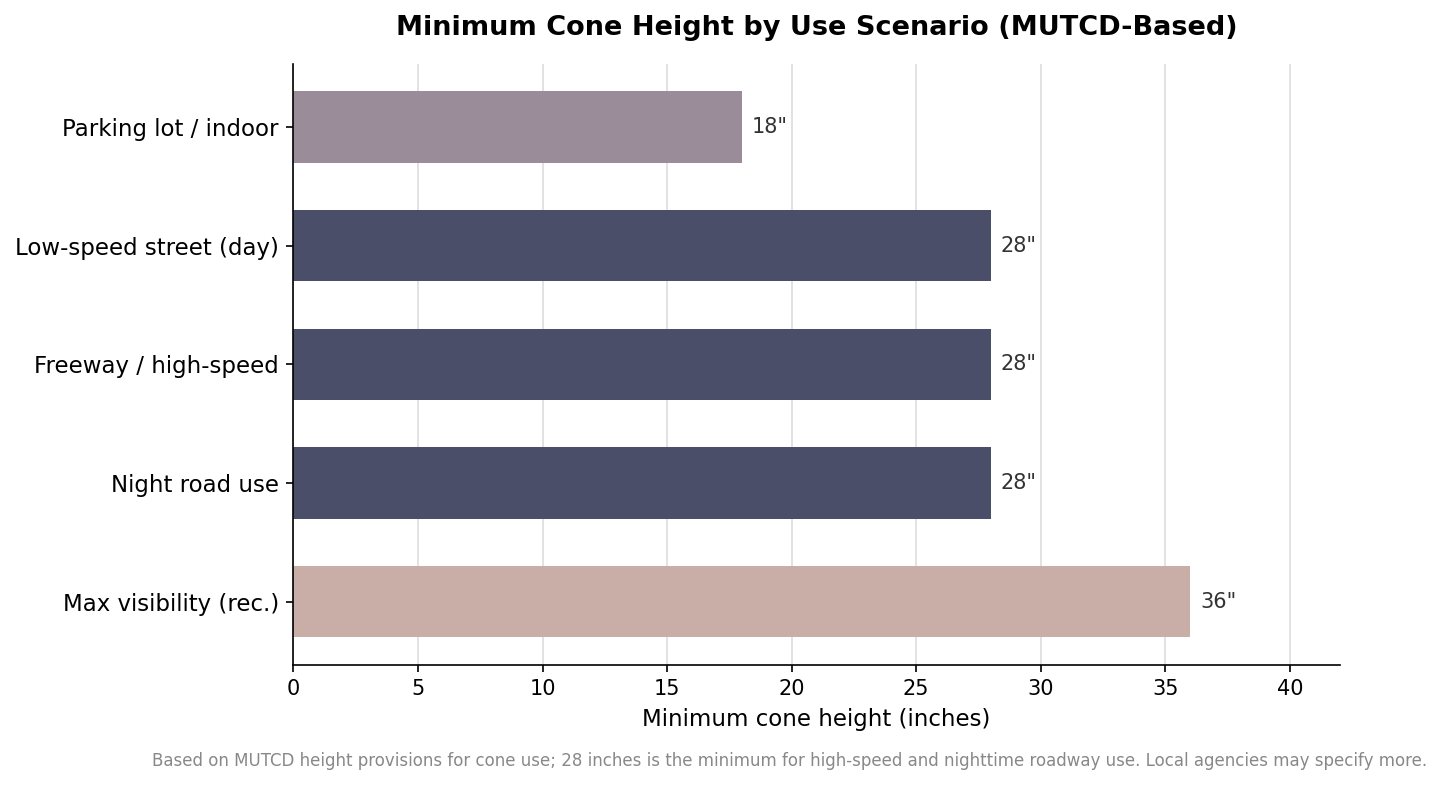
Cone height is a function of traffic speed, not a style choice. The Manual on Uniform Traffic Control Devices sets the floor. A cone must be at least 18 inches tall for general use, which covers parking lots, indoor spaces, and low-speed private property. Once cones are used on higher-speed public roadways, or at night, the minimum rises to 28 inches. For freeways, expressways, and other high-speed environments where you want maximum conspicuity, 36-inch cones are the recommended choice. The logic is simple: faster traffic needs a taller target to register the cone from a safe distance and to keep it visible past the hood of a following vehicle.
The practical takeaway is to size by the fastest road the cones will ever work on, not the typical one. A contractor who buys 18-inch cones because most jobs are in parking lots will be out of compliance the day the crew sets up along a 45 mph arterial. Buying to the demanding case costs a little more per cone and saves a scramble later.
Weight is what keeps it standing
Height gets the cone noticed; weight keeps it where you put it. A cone is a tall, light object with a broad top, which is exactly the shape a crosswind wants to tip over. Typical unloaded weights climb with height: a 12-inch cone runs around 2 to 3 pounds, an 18-inch cone roughly 4 to 6 pounds, a 28-inch cone about 7 to 10 pounds, and a 36-inch cone anywhere from 10 to 20 pounds depending on the base. Heavier cones are meaningfully less prone to toppling from wind or traffic wake, which is why the taller, road-going sizes are built with substantial bases in the first place.
The weight is concentrated in the base for a reason. A wide, dense base lowers the center of gravity and resists both the sideways push of wind and the buffeting from vehicles passing at speed. When you specify a custom cone, treat the base weight as a real performance number rather than a detail, because it is the single spec most correlated with whether the cone survives an exposed, breezy work zone.
Add-on base weights, and when you actually need them
For exposed sites, many crews add a separate ring or base weight that drops over the cone to increase ballast, commonly in 7-pound and 10-pound versions. These are worth it in three situations in particular: open, wind-prone locations with no buildings to break the gusts; roadsides where high-speed traffic generates strong wake; and uneven or sloped ground where a lighter cone rocks and walks. The chart below shows how body weight and a typical add-on stack up into total holding weight across the common road sizes.
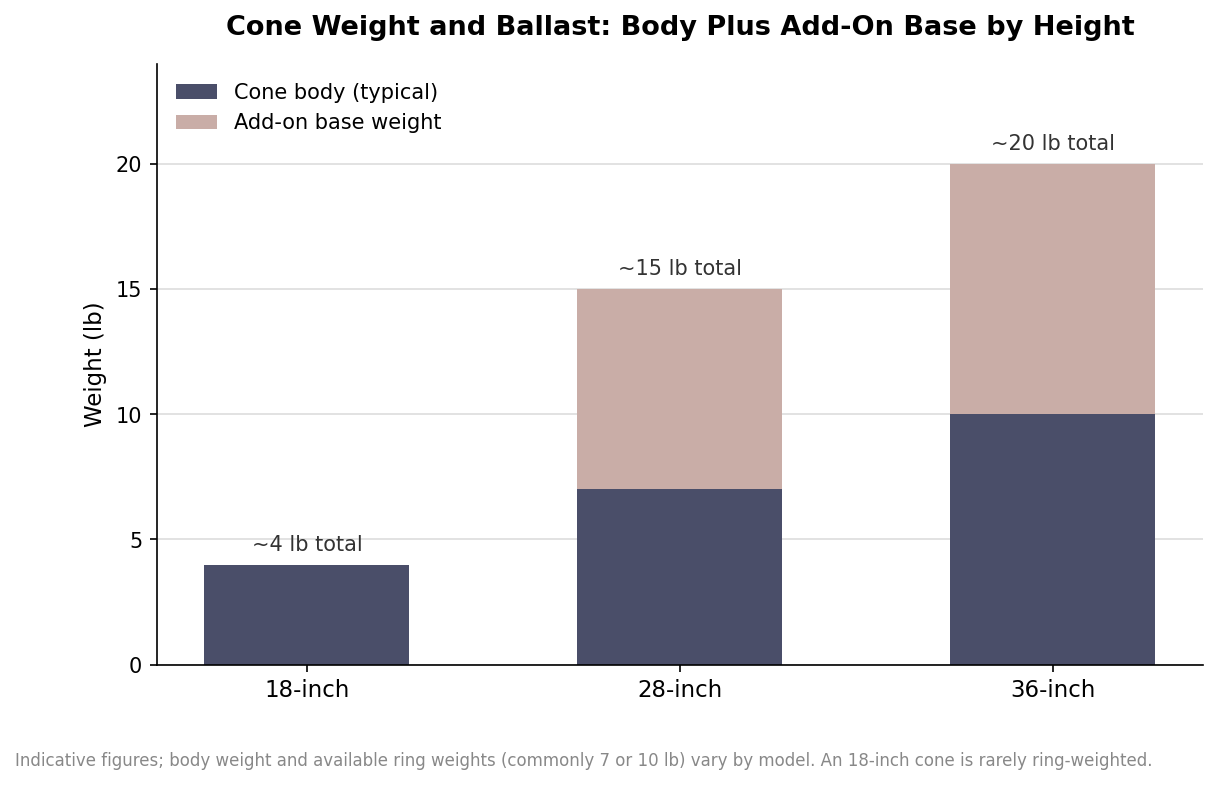
An 18-inch cone is rarely ring-weighted because it is used in sheltered, low-speed settings where its own weight is enough. A 28-inch cone at a highway shoulder, by contrast, is a natural candidate for a ring weight, and a 36-inch cone in an exposed high-speed zone often runs with the heaviest base available. Match the ballast to the exposure, not to the whole fleet uniformly, so you are not hauling unnecessary weight around parking-lot jobs.
Reflectivity and night use in one sentence of spec
Height and weight get you an upright, visible cone in daylight; nighttime adds a reflectivity requirement on top. For roadway use after dark, cones 28 inches and taller are expected to carry retroreflective collars, typically a wider band near the top and a narrower band below it, so headlights pick them up at distance. The exact band widths and placement are their own topic, but the point for sizing is that choosing a 28-inch or taller cone is also what makes proper night reflectivity possible, since the collars are specified for those sizes. It is also why night jobs and daytime-only jobs can call for different cones out of the same fleet: a short cone that is perfectly adequate for a daytime parking-lot closure simply cannot carry the collar arrangement a nighttime roadway closure requires, so agencies that work around the clock tend to standardize on the taller size to avoid keeping two inventories.
Material choice sits quietly underneath all of this. Most road cones are molded from PVC because it stays flexible enough to survive being run over and pop back into shape, and it holds fluorescent pigment well. That flexibility is part of the safety design, but it also means a cone lives or dies on its base: a supple body needs a heavy, stable foot to counteract how easily the cone itself flexes in the wind.
Putting the spec together before you customize
Work in a fixed order and the customization never fights the function. First set the height from the fastest road and whether the cones run at night, which for most road work lands on 28 inches and for high-speed or high-visibility work on 36 inches. Second set the weight and any add-on ballast from how exposed and windy the sites are. Only then choose the fluorescent base color, the reflective collars, and the printed branding, none of which should reduce the height or the base weight you just established. A custom cone is still a piece of safety equipment first, so the branding rides on top of a spec that already meets the road, rather than the other way around.