Ordering custom traffic cones is the easy part. Setting them out so the work zone actually reads as a work zone to a driver at speed is where most crews either overspend on cones they don’t need or, worse, leave a gap wide enough for a car to drift through. The spacing and taper rules that govern that layout come from the Manual on Uniform Traffic Control Devices, the federal standard that state transportation agencies adopt and sometimes tighten. This walkthrough shows how to translate a posted speed limit and a lane width into a specific number of cones and a specific layout, so you can buy the right quantity and place them defensibly.
Start with the taper, because it sets everything else
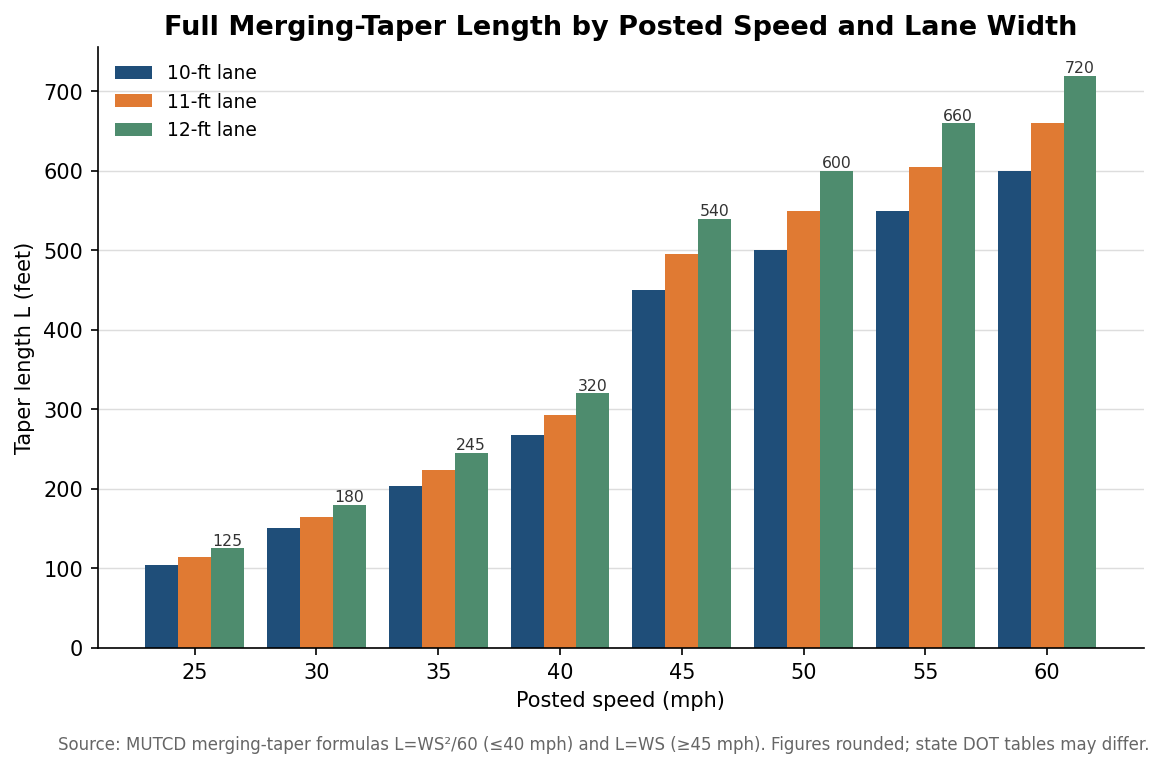
A taper is the angled line of cones that walks traffic out of a closed lane and into the open one. Its length is not a guess. For a merging taper, the MUTCD gives two formulas built around W, the width of the lateral shift in feet, and S, the posted speed in miles per hour. On roads posted at 40 mph or below, taper length L equals W times S squared, divided by 60. At 45 mph and above, the formula simplifies to L equals W times S. The jump between those two formulas is large and deliberate: a driver at 45 mph needs far more distance to react and merge than the squared low-speed formula would give.
The practical result is a table worth keeping on the truck. Shifting one 12-foot lane, a merging taper runs about 125 feet at 25 mph, 320 feet at 40 mph, and 540 feet at 45 mph. That single-step jump from 320 to 540 feet catches crews off guard constantly. Narrower lanes shorten the taper proportionally, which is why the chart below separates 10-, 11-, and 12-foot lanes rather than giving one number.
Convert taper length into a cone count
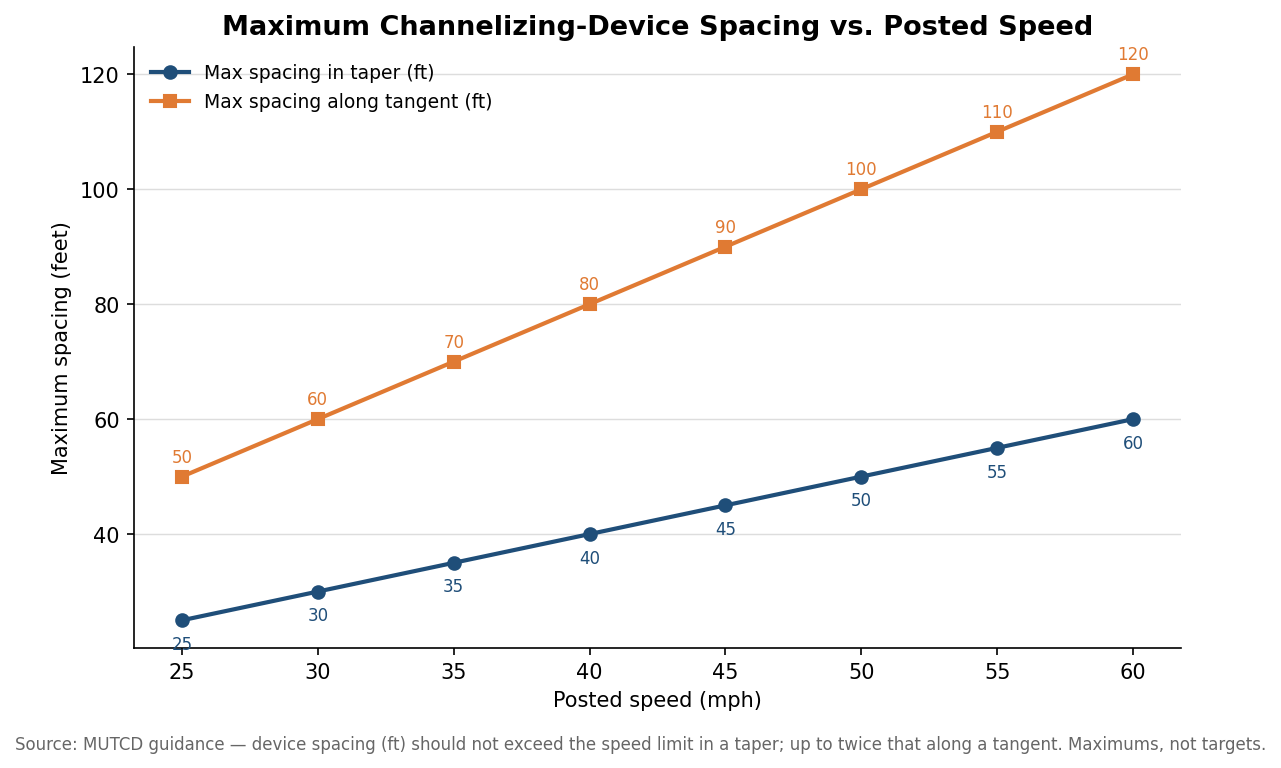
Once you know the taper length, spacing tells you how many cones fill it. The MUTCD’s ceiling is straightforward: within a taper, the distance between devices in feet should not exceed the posted speed in miles per hour. A 45 mph zone therefore allows a maximum of 45 feet between cones in the taper. Divide the taper length by that spacing and add one for the cone that starts the line. A 540-foot taper at 45 mph needs roughly 13 cones just for the merge. Drop to 30 mph, where the taper is about 180 feet and spacing maxes at 30 feet, and the same merge needs about 7.
Two points that save money and headaches. First, that spacing figure is a maximum, not a target. Tightening cones to two-thirds of the allowed gap on a curve or a crest, where sight distance is short, is good practice and costs only a few extra cones. Second, once traffic is past the taper and running alongside the work area on a straight tangent, the allowed spacing roughly doubles, up to about twice the speed limit in feet. You do not need taper-density cones for a quarter mile of tangent, and buying as if you do is where cone budgets balloon.
Match the cone to the speed, not just the job
Spacing math assumes the cone is tall enough and bright enough to be seen at the spacing you have chosen. Height is the first lever. The MUTCD treats 18-inch cones as the small end, acceptable for low-speed streets and daytime work; 28-inch cones are the working standard for higher-speed roadways and any nighttime or freeway work, and many state agencies require 28-inch or taller as a floor on their routes. If you are specifying custom cones for a fleet that works highways, ordering 28-inch avoids buying twice.
Reflectivity is the second lever and the one most tied to nighttime compliance. For work after dark or on higher-speed roads, cones are expected to carry retroreflective collars, commonly a wide six-inch band above a narrower four-inch band on 28-inch cones. When you add branding to a custom cone, keep the print off those collars; a logo wrapped over the reflective sheeting defeats the exact feature that makes the cone legal at night. Put the brand on the body below the collars or on the base.
Base weight is the third. A cone that reads correctly and then blows over in the draft of a passing semi is not doing its job. Lightweight cones in the two-to-three-pound range suit indoor and pedestrian use; roadway cones generally run heavier, with weighted bases in the seven-to-ten-pound range for 28-inch cones so they hold position in wind and vehicle wash. That is an indicative range rather than a spec, and it varies by manufacturer, so confirm base weight when you order rather than assuming it from height.
Turn the layout into an order quantity
Putting it together, a single lane closure has three cone populations: the taper, the tangent alongside the work space, and a downstream taper to return traffic. Size the merging taper from the formula, count its cones at speed-limit spacing, add the tangent run at the wider spacing, and add a shorter downstream taper. For a typical 45 mph single-lane closure with a modest work area, that lands many crews in the 25-to-40-cone range once you include spares for cones that get clipped, stolen, or cracked over a season. Ordering a 10 to 15 percent overage on custom cones is reasonable because a mid-job reorder of branded stock rarely arrives on the timeline you need.
None of these figures replace an engineered traffic control plan where one is required, and states can and do impose stricter spacing, height, or collar rules than the federal minimums described here. Treat the numbers above as the baseline the MUTCD sets, use them to buy sensibly, and confirm the specifics against the agency whose road you will actually be working on.