A custom-printed traffic cone is still a traffic control device before it is a billboard, and the rules that govern it do not bend for a logo. In the United States, the Manual on Uniform Traffic Control Devices, the MUTCD, sets what a cone has to be: how tall, what color, and how it reflects light at night. Get those right and the branding is a bonus; get them wrong and you have an attractive cone that fails an inspection or, worse, is not seen in time. Here is what the standard actually requires, and where your artwork fits around it.
Height is set by traffic speed, not preference
The single most important spec is height, and it scales with how fast traffic moves past the cone. For daytime work on low-speed roadways, the MUTCD sets a minimum cone height of 18 inches. Once you are on a higher-speed roadway or a freeway, or working at night, the minimum rises to 28 inches, and 36-inch cones are common practice on interstates where sight distance and wind wash from passing trucks demand the extra stature. Shorter 12-inch cones exist, but they are for parking lots, indoor events, and private property rather than live roadways.
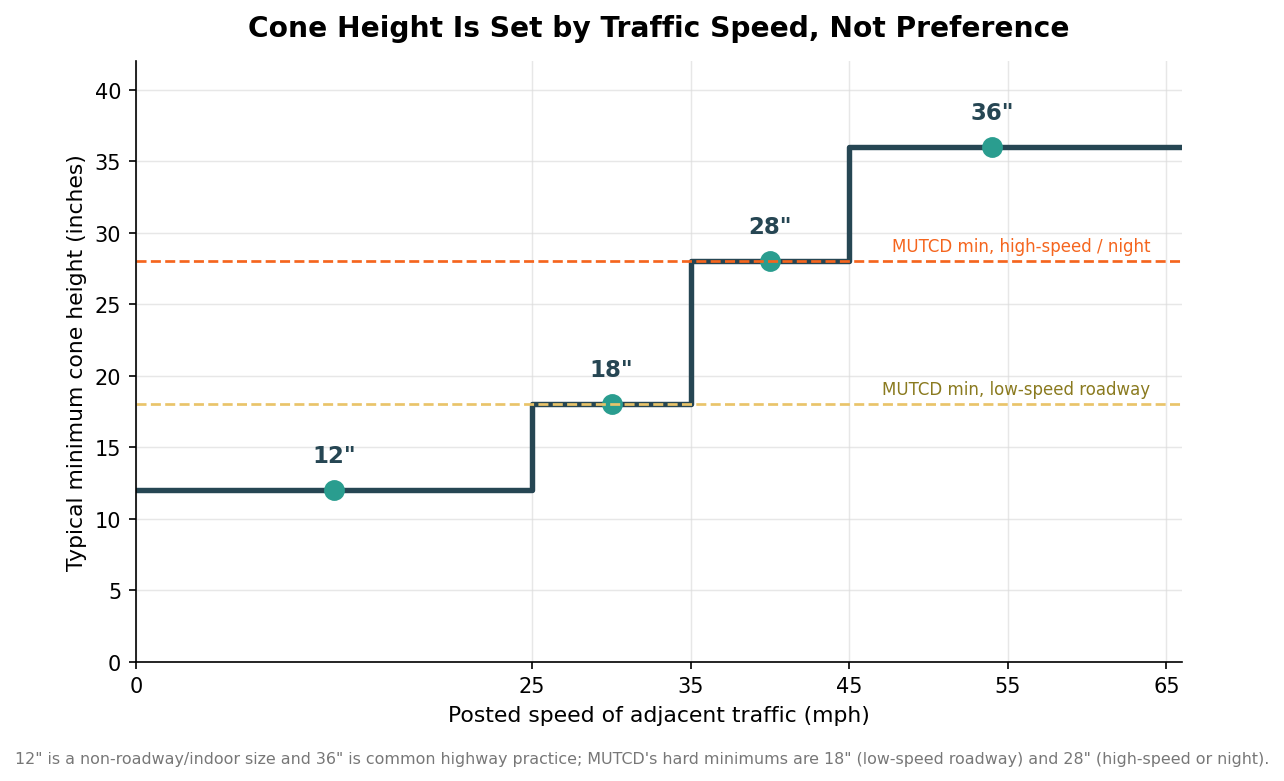
The logic is conspicuity and reaction time. A driver at 60 miles per hour covers about 88 feet every second, so a cone has to be tall enough to register in a crowded field of view while there is still room to respond. Choosing a cone one size below what the speed calls for is the most common compliance miss, and it is the one an inspector spots first. When in doubt, match the cone to the fastest traffic that will pass it, not the average.
Predominantly orange, for a reason
The MUTCD requires cones to be predominantly orange and made of a material that can take a hit without damaging a vehicle. Fluorescent orange is not an aesthetic default; it holds high contrast against pavement, foliage, and most vehicles across daylight and dusk, and drivers are conditioned to read it as a warning. Most roadway cones pair that orange body with a weighted or ballasted base so they stay upright in wind and in the turbulence trailing a passing truck, which is why base weight generally climbs with cone height; a cone that blows flat protects no one. That requirement is the first thing a custom job has to respect. Wrapping a cone in a client’s brand colors so that orange is no longer the dominant color changes the device into something the standard no longer recognizes, and it undercuts the exact visibility the cone exists to provide. Keep the orange field dominant and treat the print as an accent on top of it.
The two-band retroreflective collar rule
For cones used at night or on high-speed roads, orange alone is not enough, because color does nothing in the dark. The standard, in section 6F.64, calls for retroreflective collars that bounce headlight beams back toward the driver. On a 28-inch or 36-inch cone, that means a 6-inch-wide white retroreflective band positioned 3 to 4 inches from the top, and a second 4-inch-wide white band about 2 inches below it. Both bands are white and retroreflective, sitting against the orange field.
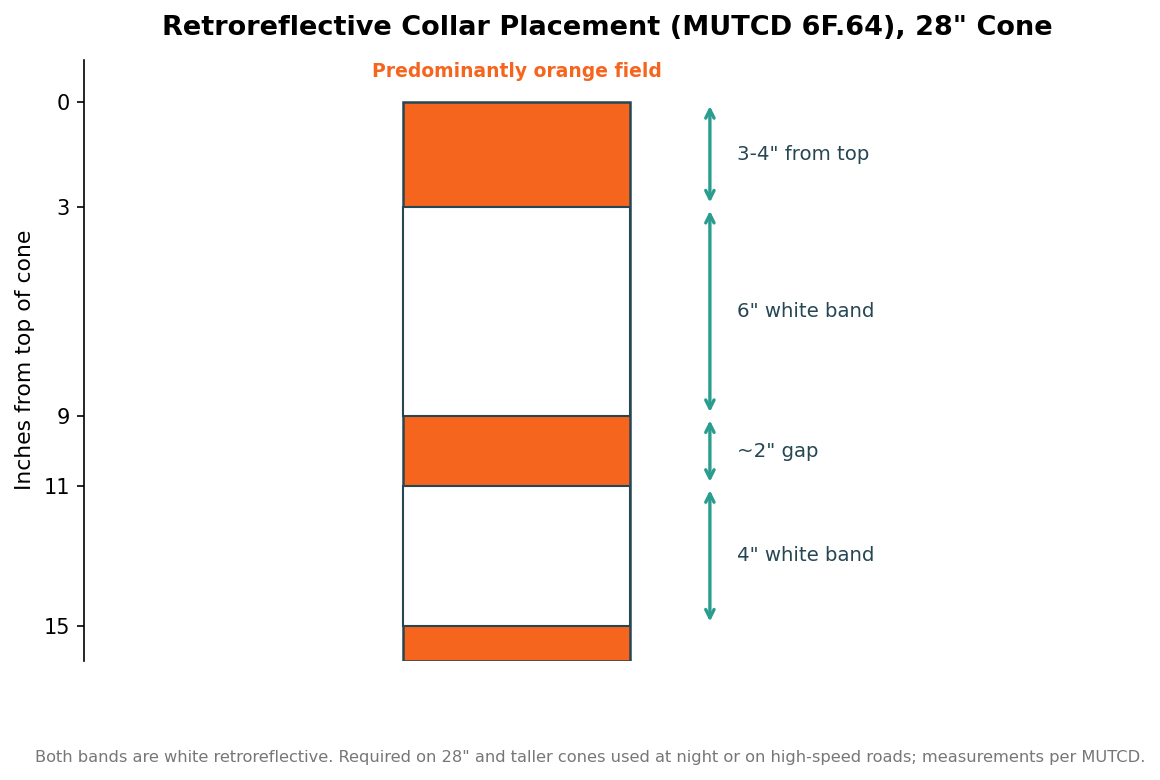
Cones taller than 36 inches follow a different pattern of alternating orange and white retroreflective stripes 4 to 6 inches wide, at least two of each, with the top stripe orange and no non-reflective gap wider than 3 inches. Eighteen-inch cones, by contrast, are defined for daytime and low-speed use and are not required to carry the nighttime collar at all. The practical rule for a buyer is simple: if the cone will ever work after dark or beside fast traffic, it needs the banded collar, and the bands need to be genuinely retroreflective sheeting rather than plain white paint or vinyl.
Where custom branding can legally go
This is where a custom program lives or dies. The two things you may not cover are the retroreflective bands and the dominant orange field. A logo printed across a reflective collar defeats the collar; a full-color wrap that swamps the orange defeats the cone. The safe real estate is the orange body below the collars and, on the cone or its base, the area that does not interfere with either the color or the reflectivity. In practice that means placing a logo or short text on the lower orange cone body or on the black weighted base, sized so it reads at a glance without crowding the safety elements. Branding a cone well is an exercise in restraint: the device does its regulated job, and your mark rides along on the surfaces the standard leaves free.
Compliance is not one-and-done
A cone that met the standard when it shipped can drift out of compliance with use. Ultraviolet exposure fades fluorescent orange over months in the sun, and a washed-out cone no longer delivers the contrast the color requirement assumes. Retroreflective bands lose brightness as they scuff, peel, or collect road grime, and a collar that no longer returns light at night is compliant on paper but not in the headlights. Build a replacement habit around visible wear rather than a fixed calendar: if the orange has gone pale next to a new cone, or the bands look gray and dull under a flashlight, the cone has aged out of its job. A branded fleet only helps a client if every cone in it still reads as a cone first.